Go here to watch this sermon on video.
***
The wilderness and the dry land shall be glad,
the desert shall rejoice and blossom;
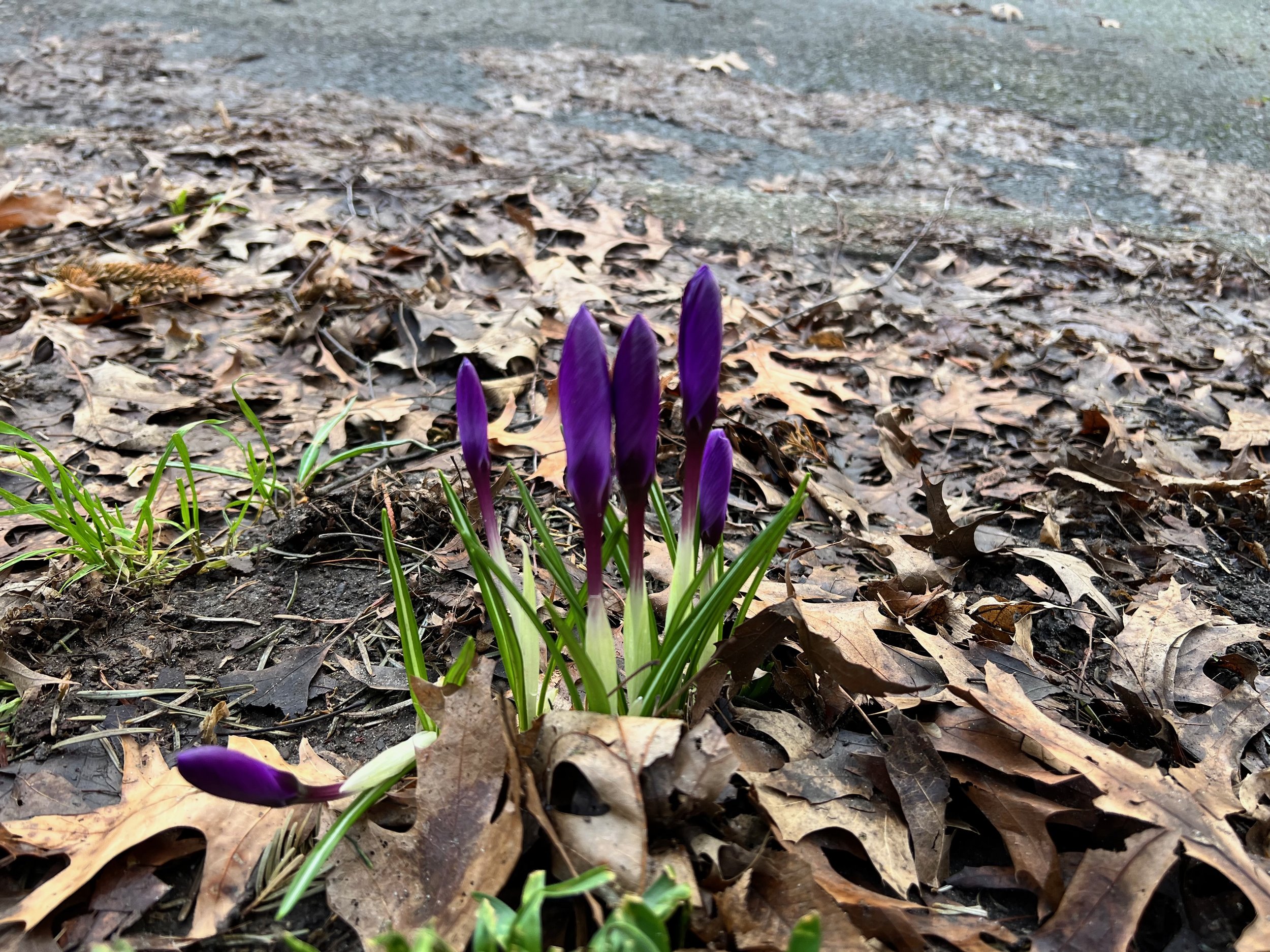
like the crocus it shall blossom abundantly,
and rejoice with joy and singing.
For waters shall break forth in the wilderness,
and streams in the desert;
the burning sand shall become a pool,
and the thirsty ground springs of water;
the haunt of jackals shall become a swamp,
the grass shall become reeds and rushes.
Long ago now, more than thirty years ago, I lived on 21st Avenue South in Minneapolis, sharing an old house with a few college classmates. One day, the city pulled up the asphalt street in a repaving project. For several days, the earth was bare and exposed. I remember different colors of earth, from black to light ochre.
My friend Bronwen wrote a poem about it. She imagined the exposed earth giving a glorious sigh, breathing with sweet relief after its release from the hard petroleum pavement. The earth rejoices upon its liberation from oppressive human infrastructure. I think of C.S. Lewis in one of his children’s fantasies, when a river god rises up from his watery realm, chanting, “Loose my chains, loose my chains,” and then the liberating army does just that: they tear down a bridge built by a tyrant’s engineers. The free people triumph, and the land rejoices. The rivers shout with joy.
I vividly recall yet another image of rejoicing land. Several years ago I watched a film that imagined the fate of the earth after the departure of all humanity. In a world fully devoid of human beings, there would first be great fires and other catastrophes as our complicated electrical and nuclear technologies, unmonitored by technicians, collapse or melt down. The toxic smoke would cause a nuclear winter, a little anthropogenic ice age, locking places like the former city of New York under many feet of ice. But regions like the American southwest, today an arid desert, today a “haunt of jackals,” would become, after all of us humans are gone, a serene, humid swamp. In what we now call the Sonoran Desert, a verdant land of reeds and rushes would flourish.
But there are many more ideas and images of the land rising up in joy, many of them (unsurprisingly) in our Bible. The prophet Isaiah sings of a happy land trodden by the returning children of God, back from their sad Babylonian exile. As they dash back home, they sing their songs again, the songs their ancestors sang as they climbed the hills to the temple. And the earth, tickled by the happy steps of the returning pilgrims, sings back to them in refrains chanted by the swampy pools of rushing, delicious, living water. In my reading of this vivid scene, happy frogs are plopping into the new rivers and pools, croaking their antiphons of praise to God. After the catastrophe, God brings the people back, and the land rejoices.
In our region this week, the land will rejoice not when it is filled with pools of water, but when the waters recede. This week, here in the Northwest, we want to sing a prophet’s song about the land mercifully drying out, with U.S. Highway 2 shouting songs of triumph as God restores the Skagit River valley to health.
And of course, today, in our time, a land that is pointedly not rejoicing is the land of the ancient Philistines, a strip of land in a region that we have named after those Philistines: we call it Palestine. Gaza lays in ruins, an arid, miserable terrain, flooded not with life-giving water but with injustice and oppression. The people of that land are far, all too far, from returning from exile. Meanwhile, in this land of the Northwest, in the land that we problematically call our land, the first peoples to arrive here are still here, but like the Gazans they also sing a song of great sorrow, after centuries of genocidal attempts to obliterate them and erase their cultures. Their songs of mourning are echoed by a sorrowing Duwamish River, still polluted by careless industry over the past century. The Duwamish is bound by many chains, built by the architects of a hostile takeover of this region.
And so, perhaps it is good that we confess our sins at church most weeks, if only for the fact that most of us gathered here are the descendants, and the beneficiaries, of human migrations that damaged this land. One small bit of contextualization, if not consolation, is that European immigrants share with every human group, every human culture, the sinful potential to harm the land. Some cultures, like many First Nations tribes, and like the people of the prophet Isaiah — some cultures powerfully rise above this dreadful human inclination, and are even poignant and prophetic about caring for the good earth. But all humans carry the potential for wasteful destruction, for hoarding and warring, for locking the vivid, ochre earth beneath a toxic, oily, asphalt blanket of injustice.
And so it is good, it is healthy, it is right and salutary that we should, at all times and all places, offer thanks to God for this land, this land that belongs always to God and not to us, this land that will join us in our song of praise, that is, if our song truly sings about real, authentic justice.
I now want to invite your attention to a particular small plot of land, land that does indeed rejoice, in the here and now. You can see it out these windows on your left. Maybe, in the passing seasons, you notice the tree branches in their cycles of growth and dormancy. Maybe you can hear the sacred silence in and around this plot of land, silence that is undefeated by the groaning buses and wailing emergency vehicles.
A quarter century ago, a few members of this parish made a momentous decision about this land. They were told by our diocese, and by a few members of the parish, that they should just pave over this corner with asphalt so that a few more people could easily park here on Sundays. Maybe we could rent the tiny new asphalt square to Diamond Parking during the week, adding a new revenue stream. That might have been sensible. It would have given us a few more square feet of usable, parkable space.
But our faith leaders at the time chose wisely. They decided to cultivate a garden on this land. This was a spiritual decision, a prayerful decision, a biblical decision. These members of our parish had been listening when the Gospeler told them, year by year, that the risen Christ appears to his followers in a garden. They understood in their bones the deeply incarnational, naturalistic ethic of our faith. They understood the assignment. They got it. “Let’s build a garden.” And so they did.
But the whole thing was a much simpler, more intimate matter for one of those members in particular. Not long ago, just this fall, she came into the office with tears of joy in her eyes. Her tears were not just hers, but also the garden’s: she lent the garden her eyes for their shared weeping. This member of St. Paul’s, this companion of ours, was overwhelmed with joy because she had just heard the sound of happy, playing children in the labyrinth garden. “This is exactly what I had hoped for,” she told Emily, our parish administrator. “This is what I dreamt of when we built that garden. I wanted to hear the sound of children here.”
The children she heard attend Three Dragons Academy, an alternative-learning community just a couple of blocks from here. They’ve been bringing their kids over here on a weekly basis for some time now, and the other week they dropped us a note. Here is what they wrote:
Thank you so much for inviting us to use your labyrinth [garden]! It’s beautiful, secluded, and we absolutely love it! The kids have decided, as a thank you, to keep filling up the little pantry out front (they understand what it is and what it’s for)!! Thank you so much!
This — this is what the land right next to us, the land beneath us, the land beyond these windows, this is what the land is rejoicing about, weeping with joy about. The land rejoices not because anyone here, years ago or now, has done or is doing anything extraordinary. The land rejoices not because this faith community is overcoming every problem and restoring the whole world to health. The land beneath us rejoices because however small we might feel, however weak we might be, however halting our steps in the direction of God’s justice and peace, with every sound of a happy child here, we hear this good news:
Here, right here, in acts of kindness that welcome children to this block; here, right here, in acts of prophecy that feed and clothe our neighbors; here, right here, in acts of mercy that console the sick and befriend the dying; here, right here, in acts of courage that confront the tyrants who harm vulnerable people and bind our rivers in chains; here, right here, the land weeps with overflowing joy, because here, right here, just here –
The blind receive their sight, the lame walk, the lepers are cleansed, the deaf hear, the dead are raised, and the poor have good news brought to them.
***
Preached on the Third Sunday of Advent (Year A), December 14, 2025, at St. Paul’s Episcopal Church, Seattle, Washington.
Isaiah 35:1-10
Psalm 146:4-9
James 5:7-10
Matthew 11:2-11