Go here to watch this sermon on video.
After this, when Jesus knew that all was now finished, he said (in order to fulfill the scripture), "I am thirsty."
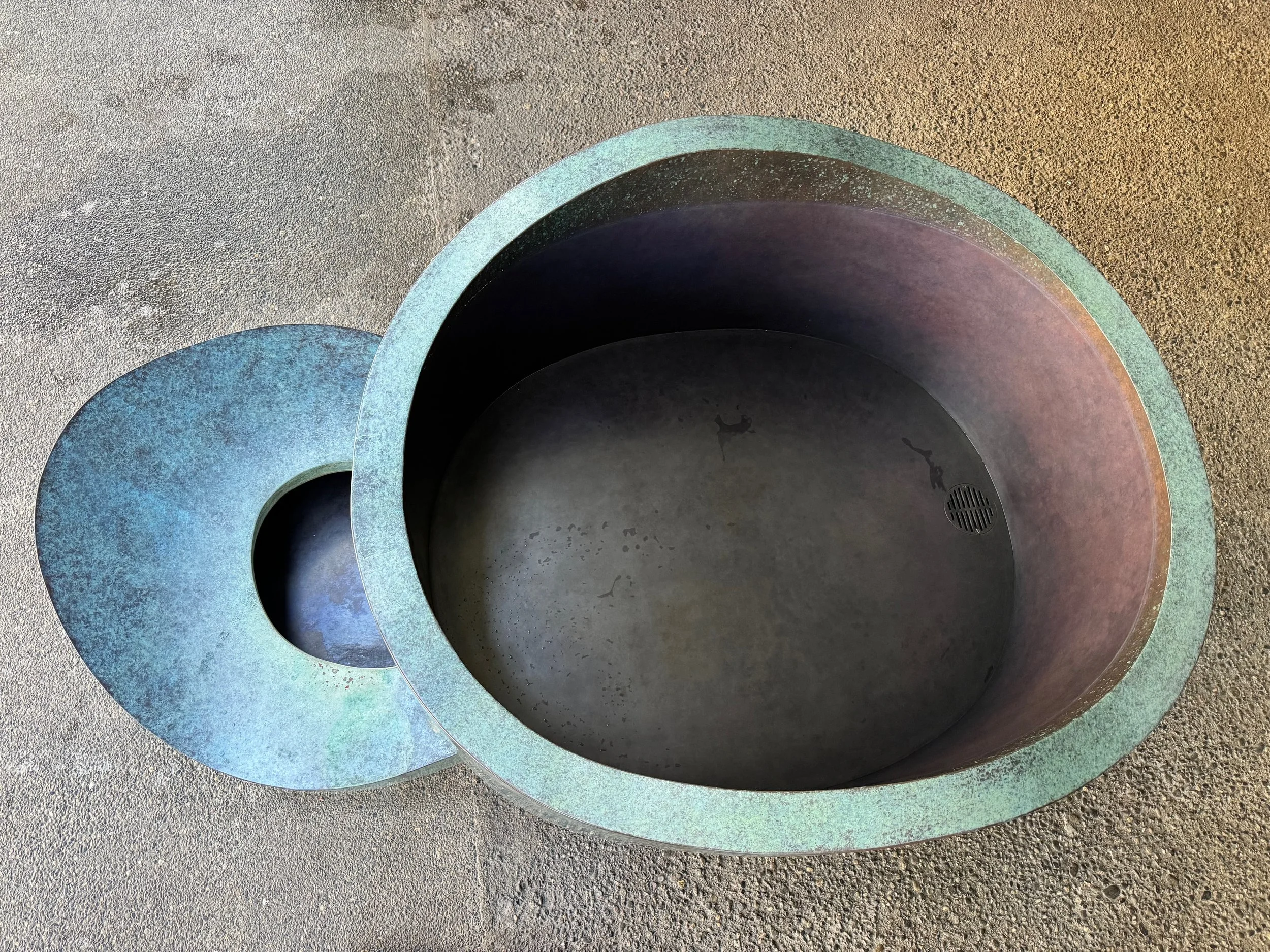
Last Friday, four of us were here in the afternoon cleaning the baptismal font. It is a mighty undertaking. There are power plugs, filters, pumps, basins, beeping leak monitors, buckets, wash towels, and hoses. It takes a long time to drain the large font, the smaller pool, the filter mechanism, and the lowest tank. It takes a long time to wipe clean all the surfaces. It takes even longer to fill it all up again. We discovered that a few bugs had met their end in the filters; they are now at rest in our garden. The whole setup of font and machinery exists on two floors of the building. Laura, Barbara, Shimi, and I took this on.
At one point I stood over the font and took a photograph of the empty basins. It is so rare to see the font bereft of all water. If you tap your knuckle on the dry inside wall, you’ll hear a satisfying clang. I asked Barbara if it would harm the machines for the font to stand empty for a time. (I was thinking it might be powerful for folks to encounter an empty font this week, on this side of Easter.) “It wouldn’t be good for the font system,” she said. The mechanism is meant to continually hold and move water.
Basins and bays and riverbeds — they are meant to hold and move water. In Tucson, Arizona, where some of my in-laws live, there are “washes,” dry riverbeds that can hold and move water during heavy rains. It is odd, if oddly beautiful, to see them bone dry. I grew up by one of Minnesota’s lakes, and when I was a child, the city of Worthington dredged that lake for many summers to prevent silt from reducing it into a swamp. Now, in this century, Lake Okabena hosts an annual international windsurfing championship. Basins and bays and riverbeds — they are meant to hold and move water.
Water is an essential element in our existence as biological creatures. Without water, we would have only two or three days to live. But water is also an essential element in our spiritual life, in our life of faith, in the Gospels we proclaim, and in the Hebrew bible that records the stories of salvation of our Jewish cousins in faith.
The Spirit broods over chaotic waters; God speaks the Word and separates those waters; God causes water to flood the earth; God ensures that the infant Moses is saved when his mother places him in a papyrus basket and sets it afloat among reeds on the river Nile; God parts the water of the Sea of Reeds to liberate the Israelites; God makes water gush from a dry rock in the wilderness; the prophet Ezekiel sees water flowing from the temple, restoring the people to life; Christians echo that ancient memory in our vision, in the Revelation to John, of water flowing through the New Jerusalem; Jesus is immersed in water by John the Baptizer, and the Spirit descends; Jesus turns dozens of gallons of water into wine at the wedding at Cana; Jesus calms the stormy waters of the Galilee (a deep lake that required no dredging!); Jesus offers the Samaritan woman living water that will forever quench her thirst.
Now, hear again — in the wake of all these watery salvation stories — hear again this remarkable word from the cross: “I am thirsty.” How can the creator of this watery planet be parched? How can the Font of living water be bone dry? How can God the Son, the Living Word who separated the waters at creation, be thirsty? This was the One who said to the Samaritan woman, “Those who drink of the water that I will give them will never be thirsty”! And later in John’s Gospel, Jesus says, “Let anyone who is thirsty come to me, and let the one who believes in me drink. As the scripture has said, ‘Out of the believer’s heart shall flow rivers of living water.’”
How can he now be thirsty?
The theologian and Episcopal priest Fleming Rutledge offers us an interpretation. In a Good Friday sermon she preached many years ago, Rutledge said: “The One who gives the calm of lakes and pools, the freshness of brooks and streams, the majestic depths of seas and oceans, the glory of pounding surf, the might of Niagara and the tinkle of the garden fountain, the One from whose being flows the gift of the water of eternal life — this is the One who is dying of a terrible thirst on the Cross for the love of his lost sheep.” (End quote.)
He thirsts by choice. For the love of his lost sheep, he rises between the waves of the Sea of Reeds, forming a wash as dry as Tucson, a safe highway from bondage to freedom.
For the love of his lost sheep, he dwells on the dry mountain where Noah’s ark comes ashore, the dry soil that bears the relieved footprints of Noah and his family.
For the love of his lost sheep, he is the hard rock in the wilderness, water gushing from him so the people may live.
For the love of his lost sheep, he empties himself of water — he becomes thirsty — to invite the Samaritan woman into a thirst-quenching encounter, one that restores her to her community, and evangelizes them all.
For the love of his lost sheep, blood and water gush from his body in death, like the water we can hear right now, cascading into the lower basin of our sparkling-clean baptismal font.
All four of the souls who cleaned that font last Friday have thirsted for water, living and otherwise. I am not authorized to tell you their stories, but I can assure you — like you, all four of us have known thirst. All of you, in your baptismal life, pour out living water in loving service for the lost sheep of Jesus our Good Shepherd. And all of us thirst for answers, for peace, for forgiveness, for courage, for love.
Blessed be the Crucified One, the Thirsty One, who joins us by choice in our thirst, so that he might quench it in a gushing of resurrection water that will soak the whole earth with God’s creative outpouring of love.
***
Preached on Good Friday, April 3, 2026, at St. Paul’s Episcopal Church, Seattle, Washington.
Isaiah 52:13-53:12
Psalm 22
Hebrews 10:16-25
John 18:1-19:42