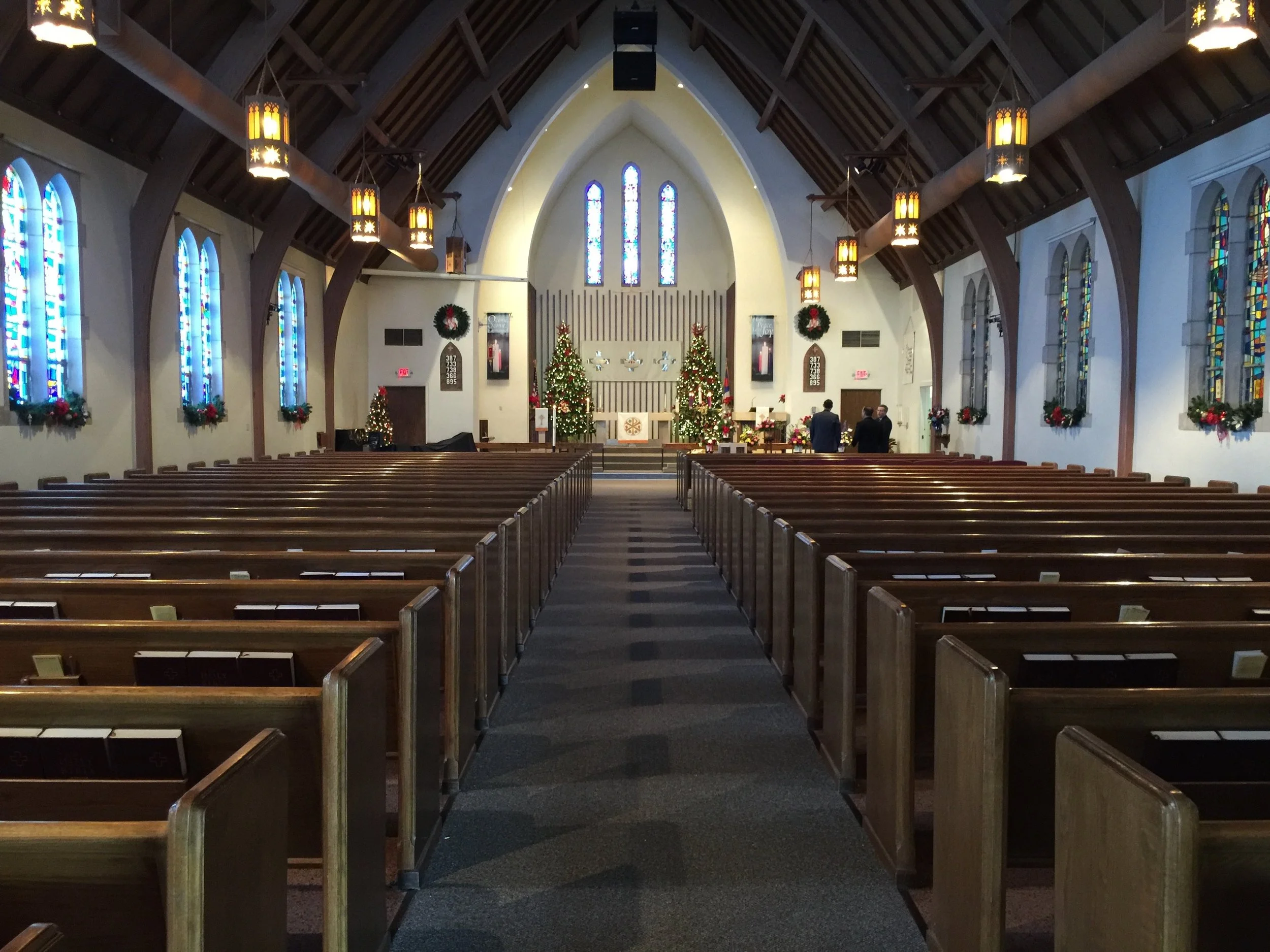
The sanctuary of St. Matthew Lutheran Church, Worthington, Minnesota, where I was baptized as an infant and was a parishioner from 1970 to 1984.
“I’m just this kid from Worthington.” That’s something I like to say in text messages with a certain friend of mine, signaling real (if playful) modesty after I say something highfalutin or pompous. I’m not uppity. I don’t have a big ego. I’m just this kid from Worthington.
My friend was born in Jonesboro, Arkansas, and for a time lived in Rock Island, Illinois. He’s married to someone who grew up in Davenport, Iowa. I’m married to someone born in San Jose who lived in Tucson. I know very few native New Yorkers, and even fewer – nearly zero – native Parisians or Londoners or Tokyoites.
Maybe you come from somewhere famous, a top-tier city. Or you hail from a blue-blood family line. Are you the scion of a dynastic clan? My father was interested in genealogy and discovered a thin but durable connection between our family and a passenger on the Mayflower in 1620. But that is now a dubious distinction, given what we’ve learned, all too recently, about the impact of English colonists on this continent.
I am not the son of a royal house. I am not a Windsor or a Kennedy or a Bush or a Kardashian or a Hilton. I did not attend an Ivy League school.
I’m just this kid from Worthington.
Worthington: a little town that grew up by a lake and a railroad crossing in remote southwestern Minnesota. I have no doubt none of you has ever been there. Many of you may have unwittingly flown over Worthington: it’s deep in ‘flyover country’. When they opened a Hardee’s fast-food joint in the early eighties, we kids rejoiced. These days it is known for an international windsurfing festival, held on the shores of Lake Okabena, where the waves are whipped high by prairie winds. But you have not heard of that festival. I’m almost sure of it.
Robert Kennedy (senior) visited Worthington in 1966. They say the crowds swelled to about 80,000 on that historic day. But in the six decades since, my hometown has not made national news.
Can anything good come out of Worthington?
Nazareth, in turn, has produced only one famous resident. Well, two. Okay, three: Jesus and his parents, Mary and Joseph. They are, of course, historically famous, their fame many orders of magnitude huger than that of the most media-savvy Kardashian. They have changed the western world. The eastern world, too: they have changed the whole world.
But there was a time when a kid from Cana in Galilee could look derisively on a kid from Nazareth. Did you grow up in Edmonds, Washington? If so, maybe you are a modern Nathanael, saying with derision, “She’s from Puyallup. Can anything good come out of Puyallup?”
This is the scandal, the absurdity, of the incarnation. Those who first heard the Christian Gospel were understandably perplexed, sometimes even outraged, by the idea that God, who created the universe and whose purposes for the universe will always far transcend the human imagination — that God comes among us as an ordinary human being from the next town down the road, an itinerant preacher and folk healer, an executed peasant prophet, a kid from Nazareth. God comes among us as a human person, just like you and me. How ridiculous!
There are human beings around most of you right now, to your right or to your left. (Some of you watching the livestream may be alone in your room.) Speaking of livestream, our livestream manager, trained in the world of audio and video technology, calls us human beings “bags of water.” (That’s our physical impact on the sound quality in this room, at least. We’re lumps who deaden the sound.) But that is actually what we are: bags of water, bundles of bones and nerves, tangles of guts and veins, with ingrown toenails and slimy ear wax. God became one of us?
Yes, says the Christian. God comes to us as a bag of water, born in the hinterland, sitting next to us in the pew.
But… assuming for a moment that God can do this, why would God do this? Back to Nathanael, who snarks: “Can anything good come out of Nazareth?” This sharp question is a diplomatic (if arch) way to say that Jesus was a hick, a hillbilly. And Nathaneal would know. He was found under a fig tree, an image meant to evoke scholarship: working-class folk did not rest under fig trees during work hours. That takes the leisure of a scholar. Nathanael was probably what we’d call lettered: an educated man, probably erudite. He comes from Cana in Galilee, which is not an imperial capital, not a glittering urban paradise: no, Cana is hardly more distinctive than Nazareth, making Nathanael’s contempt for Jesus more than a little absurd. (He was probably projecting…) But Nathanael nevertheless is educated, world-wise, savvy. (Something good did come out of Cana.)
And so Nathanael is a decent stand-in for us, who mostly share his access to education, his worldliness. Nathanael is our way into today’s Good News. It’s our turn to ask: Can God come among us as a human, and if so, why would God appear as a hick from the hills, an unknown redneck, a dusty tradeworker? Why would God carry divinity all the way down to earth, all the way down to a basin of grimy water he uses to wash our feet?
Answer: The incarnation drops from the heights of heaven — from the realm of angels — all the way down to our dirty feet so that the whole world can be reconciled to God. The Good News finds its way into every bag of water. You may have humble beginnings and an unremarkable life history, but God comes to you. God is embodied in you. You are invited to be part of the incarnation, to be caught up in it, to be lifted ever higher, through the realm of angels, to abide with God, in Jesus.
And: it’s always been this way, since the time of the first Christian communities. Let’s take a quick second to look at who they really were.
It’s easy to read the New Testament and imagine our first Christian forebears as sophisticated urbanites. The early Church flourished in grand (or at least grand-sounding) cities: Rome, Antioch, Alexandria, Constantinople, Jerusalem. But those cities were not at all huge by our standards. Tokyo would baffle them in its daunting immensity.
Cities like Philippi and Corinth were even smaller. They were dense little towns, their tight neighborhoods crammed with humans. Privacy was almost non-existent. The biblical scholar Wayne Meeks describes these compact little urban villages. He writes, “A peddler of copper pans or magic amulets, of horoscopes or a revelation, could count on the word [of his trade] getting around — once he had made his initial contacts.”
The Word of God was made manifest in the unremarkable alleys and lanes of towns that dotted the Mediterranean. And those little communities, following a kid from Nazareth, banded together and changed the whole known world. The Gospel made it to the tiniest town, the most far-flung village, the most overlooked railroad crossing in flyover country.
And so I encourage you to relax, to take a breath, as you sit and reflect on this morning’s Good News. God comes close to you, an ordinary human being who likely was born in unremarkable, ordinary circumstances. God comes close to you, a tax-paying voting citizen who’s worried whether you can afford retirement. God comes close to you, an undocumented partner in ministry who has to research how to get a visa, and what to do if that’s impossible, in a time when being found by our government without documentation could mean the end of your life. God comes close to you.
And just listen to what that kid from Nazareth says to Nathanael, a kid from Cana who is climbing a near-vertical learning curve as it dawns on him that this Nazarean is really, vitally, ultimately important. The kid from Nazareth says Nathanael “will see greater things” than the seemingly clairvoyant awareness Jesus had of Nathanael’s whereabouts and identity. “Very truly I tell you,” Jesus says, “You will see the heavens opened and the angels of God ascending and descending on the Son of Man.”
This cryptic statement foretells a few things. Jesus was likely referring to the first wondrous sign of his identity and mission that will happen at Nathanael’s own little Cana in Galilee, where Jesus will turn hundreds of gallons of water into fine wine, a dazzling sign of the abundance of grace that God brings to earth in the form of this ordinary kid from the sticks. But Jesus was also likely referring to his resurrection and ascension, when he himself will climb Jacob’s ladder back up to heaven, completing the incarnation.
The Word of God descends from cosmic glory into the earthy, workaday world of a backwater town in an unremarkable countryside, and further down still, finally kneeling in jaw-dropping humility at the dirty feet of his friends. Then he rises up, up, up to heaven, and he takes us with him. The incarnation — incarnation, a word that means in-flesh or enfleshed — is not only the descent of God into our messy human world. It is also the journey back up, and we get to come along.
The ingenious architects who designed this building wisely gave us a room that illustrates this parabolic path of incarnation. If you look to your left and right, you’ll notice a cozy intimacy: Even at 8:00am, when just a dozen or two people occupy this room, it doesn’t feel cavernous or empty. You can readily see the faces of your friends.
But then, look up. Gaze up at the skylights dozens of feet above you. See how the columns, like huge tree trunks, rise into the sky and turn this room into a great forest glade. God is immanent here, but God is also transcendent from here.
And so it is with you. Maybe you feel you have a little life, that you’re making a small, insignificant impact, that there isn’t much you can say or do about the roiling world so beset by injustice and atrocity. But then, look up. You may have been born in the middle of nowhere, but here, around this Table, you become a member of Christ’s Body, and there is no action of yours so tiny that it won’t make a surprising positive impact on this beloved world created by God.
You, a kid from an unremarkable town: You will do greater things than these.
***
Preached on the Feast of St. Michael and All Angels (transferred), September 27, 2026, at St. Paul’s Episcopal Church, Seattle, Washington.
Genesis 28:10-17
Psalm 103:19-22
Revelation 12:7-12
John 1:43-51 (verses added to the appointed Gospel)