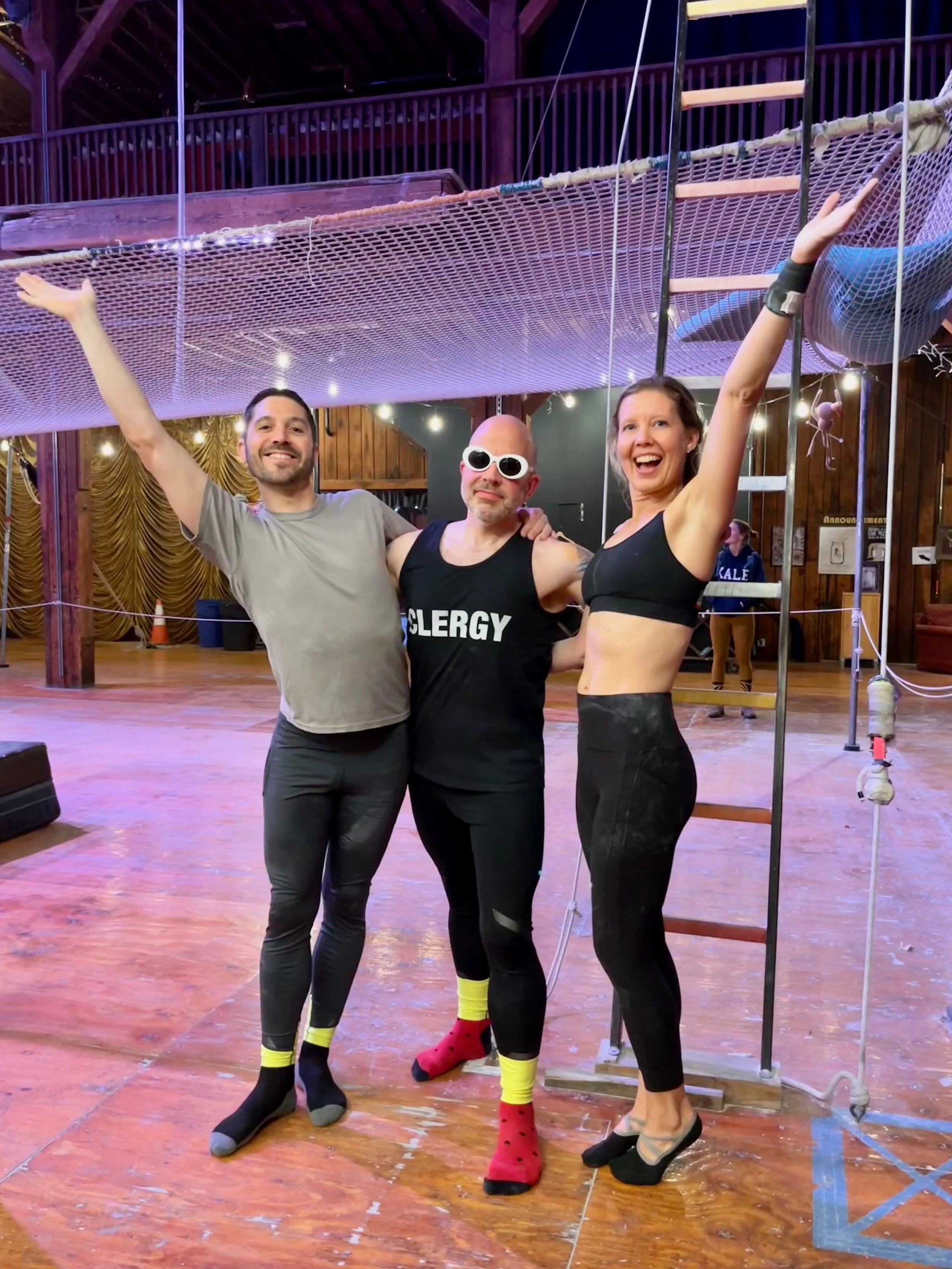
The three of us after flying the trapeze.
Some years ago now, in my previous call as a priest, I served as the interim rector at Grace Episcopal Church on Bainbridge Island. For the final full year of my time there, the wardens were Luke and Heather, younger members of the parish, both of them 30-something, active, and even athletic. Heather was (and still is) a trapeze artist, among many other impressive avocations. She develops her skills at Emerald City Trapeze Arts, in Sodo.
Heather and I would talk about exercise and fitness, in the course of our conversations about all things church. It wasn’t long before she invited me to join her at Emerald City Trapeze Arts, as part of a beginner class. I would actually fly trapeze, alongside other terrified newbies. I resisted. I tried to laugh it off. I really couldn’t imagine actually doing it.
But Heather knew my number. She knew how to get me to do it. “Oh it’s okay,” she said, deviously. “I know it’s scary. You probably wouldn’t want to take the risk.” Oh, well, now it’s on. Now there’s no way I won’t do it. “Name the date,” I said. We set it up, and looped senior warden Luke into it as well. “Sure!” he said, ridiculously. “It’ll be fun!”
And so it came to pass that the three of us went to Emerald City Trapeze Arts, dressed in nylon and ready to fly. You climb a long rope ladder, and when you get to the top, you stand on a tiny plank of wood. You grab a wooden bar hanging by ropes, and then you jump. There’s a net to catch you if you fall, but it is far below you. You are jumping into a literal abyss, and once you’ve jumped you have to immediately wrangle your legs over the bar so that you can hang upside down, the bar behind your knees. As you swing, your next job is to prepare yourself to be caught by another person on another swing, who will then release you, for you to then tumble in somersaults to the net.
After a few practice rounds in which we didn’t have to be caught by another person, Heather said, “Okay, now you need to get swinging and release your upper body backwards so that As You Wish can catch you.” “Sorry?” I said. “Who?” “Oh!” Heather replied. “‘As You Wish’ is just what we call him,” pointing to the staff member who was helping lead the class. He was a terrific-looking trapeze artist who reminded the women of the actor Cary Elwes, who played Westley in The Princess Bride. “As you wish,” Westley famously says in that film.
I did not, finally, manage to be caught by As You Wish. I couldn’t figure out how to relax my upper body in the right way. I was confused by the backwards perspective I needed to have. As You Wish managed to touch my hands, but I slipped away and somersaulted down to the net.
But hey, I flew trapeze. I did it! I faced the scariest part, which was far and away that terrible moment when I stood on the tiny wooden plank and looked down. I had a vertigo sensation; I felt a cold terror. It was horrible.
But I jumped. I did it. I faced it.
And I immediately sensed that this was a spiritual experience, a deeply profound human activity that taught me something worth learning about myself, about God, about the universe, about the depths of terror and horror that we all occasionally feel, about the heights of courage and strength that we all have the capacity to reach, with God’s help. I prayed on that plank. I whispered, “Help me.” I needed God’s help to jump into the abyss.
The abyss: I believe we all have at least one. We all know of one. My spiritual abyss is a product of my own anger and fear, a hellish existence that I have sometimes known, on terrible days. Hell for me is a stuffy, dull, Tuesday-afternoon kind of feeling, powerfully lonely, a mental and emotional state in which I feel bereft, rejected, abandoned. I make it more hellish when I am ruminating on a mistake I made, or reflecting on something I said or did that may have damaged or upset someone else. In my retreat last week, with help from skilled facilitators, I practiced meditation techniques that help me locate the power God has given me to raise myself out from that terrible place. I got in touch with God’s power, which pulses in our physical bodies, enlightens our minds, opens our hearts, and fills our spirits. God’s power helps us jump into the abyss, because God’s power assures us that we know how to get out of it.
I jumped in that trapeze class because finally I knew that I would survive, I would be okay, I would not be jumping to my own destruction. I would swing back up. I would tumble safely into the net. All would be well.
Today we stand together, all of us, on a little plank of wood we call the twenty-fifth chapter of the Good News according to Matthew. We have struggled through this apocalyptic chapter for three weeks now. Matthew has given us troubling and baffling parables about the end times, and now we are in the Sistine Chapel, gaping at the terrible scene of Christ in glory, judging all the people, separating sheep from goats.
Why does religion have to get so stark and scary? How is it helpful, in this era of chronic fear, with all the world in awful upheaval — how is it helpful to contemplate the Last Day, the Day of Judgment? We do hear serene reassurances today, about how God will take the good sheep out into the verdant countryside to graze, well assured of their safety with such a good shepherd taking care of them. We hear in Ezekiel this warm reassurance: God says, “I will seek the lost, and I will bring back the strayed, and I will bind up the injured, and I will strengthen the weak, but the fat and the strong I will destroy.” And then, my favorite line in the passage: “I will feed them with justice.” I taste a dash of salty humor in that line. God is not just powerful and good; God is also ironic and funny.
But again, the Last Day in Matthew is more unsettling than reassuring, more fearsome than majestic. We are all judged by the Son of Man, the Son of the Human One, the human Messiah, the risen Christ. All the world is his throne room, and all of us are in a queue to be evaluated. This is unnerving, and it is meant to be so. Once again, Matthew’s community is deeply concerned about the mission. We are not merely invited or encouraged to feed the hungry, welcome the stranger, clothe the naked, take care of the sick, and visit those in prison. Matthew hammers it home: we must take care of these people. Whether or not we help them will determine our ultimate identity, and our ultimate destiny.
You could imagine Matthew the evangelist saying this to us: “You better go on the SPiN walk through Uptown today, passing out soup and blankets to our neighbors. You better go on that walk, or else.”
But it isn’t really that. Matthew isn’t bullying or abusing us. Matthew isn’t manipulating our emotions, guilting us into doing the right thing, threatening us with our own doom — threatening us that if we don’t cooperate, God will throw us into the abyss.
It’s not that. It’s this: The tasks of feeding, welcoming, clothing, caregiving, and visiting: these tasks are everything in our life of faith, they are the reason we have faith — and they are hard to do. They are scary. When we feed the hungry, we are reminded that we too could die of hunger. When we visit the sick, we are reminded that we too have been sick, and we will be sick again, and one day we will die. When we visit those in prison, we are reminded that our personal freedoms and dignity could easily be taken away by the same powers and principalities that have locked our friends away.
Recognizing Christ in the faces of the poor and the oppressed, the hungry and sick and lonely people: this is hard, and scary, to do. It’s far easier to worship the Lord God who rides the wings of the storm, or sing a hymn to Jesus our warm and powerful Good Shepherd, or praise the Spirit who blows where she wills, inside and between us. If we find God in the desperate face of a neighbor in need, that is scary. It reveals our own vulnerability.
And sometimes it reveals our culpability: we participate in the unjust economic system that pins some down while lifting others up. And finally human intimacy is always scary. If we feed, welcome, clothe, and visit our neighbor, we have to get close to them. What if they see our flaws, our shortcomings? What if they see that we are frightened of them, or don’t necessarily like them? We are taught that loving our neighbor is the whole point of our faith, the whole reason for our own existence: and we know well that love is costly, love is scary, love hurts.
Now, please hear again, and hear clearly, this Good News: The foreboding and even terrifying scene of the end times in Matthew is not proclaimed in our hearing to scare the hell out of us, to threaten us with harsh judgment and condemnation. The alarming fear of the Last Day proclaims instead the hard truth that our faith is scary, our mission is daunting, and even our own capacity for goodness, and our own immense strength, can frighten us. I stood on that plank at Emerald City Trapeze Arts and was scared by my own hubris. “What have I gotten myself into?!” I said to myself.
Today we gather here to be confronted with the daunting cost of love, the unnerving difficulty of the mission, the scary vitality and importance of our calling as baptized Christians. What have we gotten ourselves into?
But God is here with us. The shepherd stands alongside us, watching out for us. There is no task or challenge that we must face alone, and no matter how far down we fall, God will give us the power to rise back up. This is life in the Spirit — often scary, unpredictably exciting, sometimes terrifying, other times heartbreaking, occasionally overwhelming. It’s a lot.
But it’s worth it. Our neighbors are worth it. You are worth it. And God is here with you. So what are you waiting for? Take a breath. Get set.
Jump!
***
Preached on the Reign of Christ (Last Sunday after Pentecost, Year A), November 22, 2026, at St. Paul’s Episcopal Church, Seattle, Washington.
Ezekiel 34:11-16, 20-24
Psalm 95:1-7a
Ephesians 1:15-23
Matthew 25:31-46