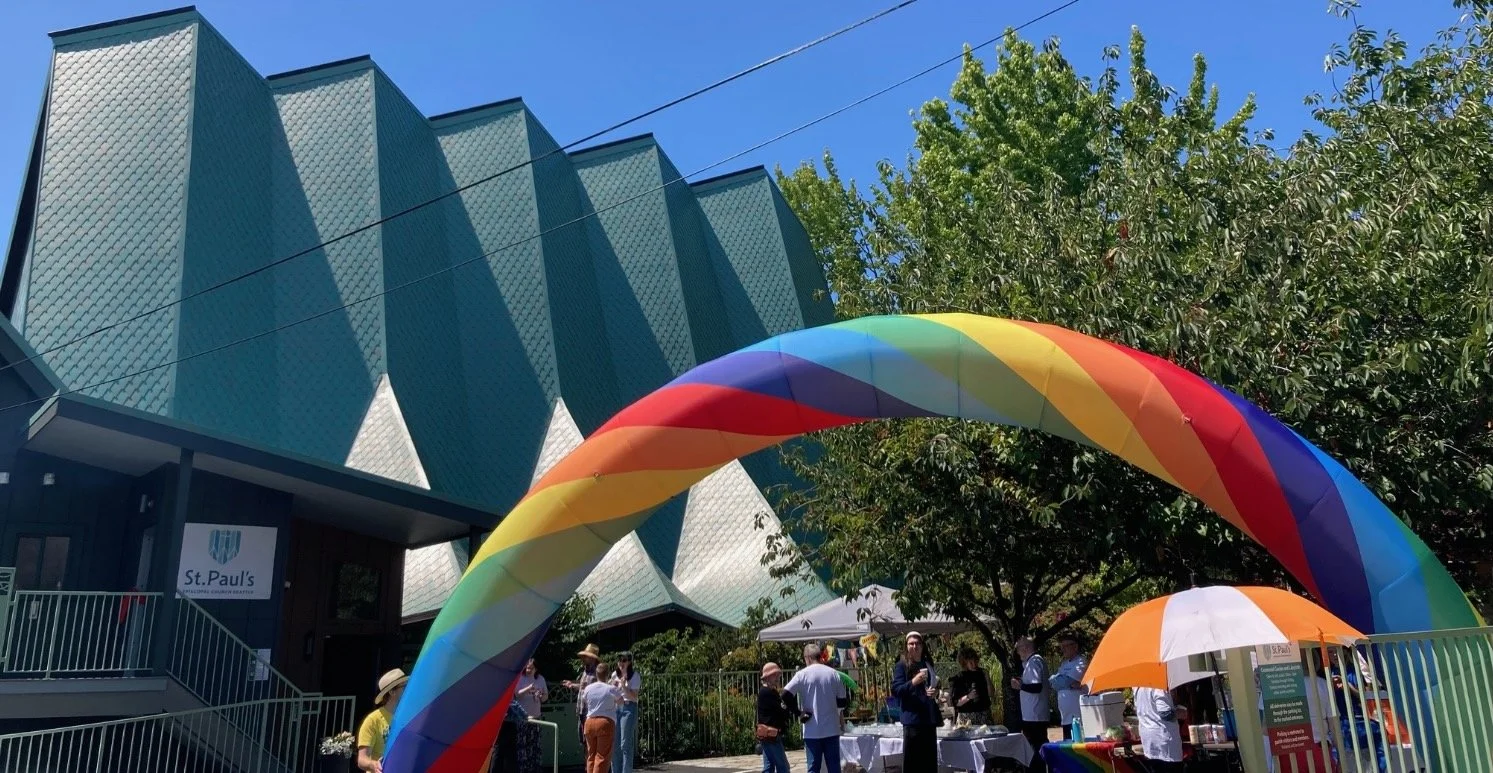
The entry to our buildings and grounds from First Avenue North, June 28, 2025.
A couple of years ago, we completed the construction of a fence around our whole property, with one major gap at our driveway on First Avenue North. To fill that gap, we installed a rolling gate, lockable with a combination padlock. We roll the gate open for four hours most days of the week, when our office is open, and we open it many other times, for various events.
Our new gate raises one issue to consider. Our mission primarily focuses on our neighbors in Uptown, many of whom experience housing insecurity. Doesn’t this gate belie our claim that we are advocates and allies of our neighbors? About a year ago, someone said that when we threw a big party with the bishop to bless our renovated buildings, they didn’t want to celebrate with us. The gate was their reason. For them, the gate communicates division and privilege: we are safe inside the gate, and our unhoused neighbors are outsiders. This person wanted to firmly stand with them on the other side of our gate, in solidarity.
But this person did not know what many of us know, and what I am now telling all of you: this gate of ours provides safety to everyone on both sides. When the gate was installed, a person lived in a tent at the edge of our driveway, as he had done for many, many years. Before the gate, there was a disturbing atmosphere of disorder and neglect on this part of the block, and that meant that our neighbor — someone we knew by name, and someone we finally helped to gain permanent shelter and receive medical care — our neighbor was routinely a victim of violence.
Before the gate, people would come into the garden at all hours and start fires, one of which very nearly killed him. Other people would assault him, occasionally leaving him bleeding at the curb. After the gate, these incidents abruptly stopped. But our mission continued: we pulled out our SPiN wagons every Sunday, as we will again today; we stocked our Little Free Pantry every day of the year, as we will again today. Our neighborhood missioners continue to advocate for folks with confidence and skill. The gate helps regulate our mission base so that everyone feels safer, and we can follow the risen Christ more confidently.
I even wonder if drivers on First Avenue North are a little more careful now, unconsciously driving better because they see our soft-green gate, and our soft-green fence, and our green garden, and our renovated buildings; and maybe they occasionally see us going about our mission with our neighbors; and when they see all of these good things, they drive a little more calmly, a little more carefully. I do not know if this is true. But I do know that before the gate, drivers would occasionally strike our neighbor lying at the edge of the driveway, or come very close to doing so.
And so we have learned that gates are sometimes good, even necessary. They are literal physical boundaries, and what is a boundary in human society? A boundary is a rule or guideline that regulates a relationship, for the health and safety of everyone. As your pastor, I am obliged to observe boundaries with you that regulate what I say to you, how I say it, how and when I respond to your concerns, how and whether I receive your gifts, and much more. When we manage boundaries with one another, everyone is safer and more secure.
All of this draws my attention, focuses my mind, and lives in my heart when I hear Jesus say to us, “I AM the gate.”
You can be sure that when Jesus says this, he is not thinking of a wrought-iron gate on rollers that elegantly opens and closes. Remember that when Jesus says, “I AM the gate,” he is living in the ancient Levant, under imperial occupation, centuries before the industrial revolution. The walls he knew that formed pens for livestock would be little more than low stacks of assembled stones joined by rough masonry, with a rough gap for entrances and exits. And the gate? The gate is the vulnerable body of Jesus himself. Jesus the Gate lays his body down in the gap of the low wall. He sleeps there. If bandits or attackers try to get in, they will have to trample his body first.
Does he have, I don’t know, a sleeping bag? Some sort of pillow? I doubt it. Maybe a rough blanket. Or maybe, by laying down in the dirt to form a living gate, maybe Jesus is like our ancestor Jacob, who camped on the ground at Bet-El, what we call Bethel, a word that means House of God. Jacob slept there one night and made a stone his pillow. He was in that lowly place when he saw a vision of angels ascending to heaven and descending to earth. That lowly bed, in the dirt, his head on a stone, is the unlikely place where Jacob proclaimed that he was in the House of God, that he was at the Gate of Heaven.
And so we might say that when Jesus tells us, “I AM the gate,” he means this: he is the Human One who sleeps down in the dirt, vulnerable all night, for the life of the flock. He is the stone pillow, the hard rock that forms the rough threshold of God’s House. He is the gate, the Gate of Heaven, the One who raises up the lowly in dignity and honor, the One who feeds the hungry with intimacy and gentleness, the One who risks his own life — the One who loses his own life — so that the vulnerable and the oppressed can live, and rise, and thrive.
All this vulnerability, all this weakness, all this down-in-the-dirt struggle and angst! This is our risen Lord; this is his Way. Last Sunday we proclaimed again the Good News of weary evening hikers recognizing Jesus in broken bread. They gaped in astonished recognition of the Risen One’s body, still gashed with dreadful wounds. Sitting at a rough-hewn table with them, out in the country, he lifted his bruised hands to break the bread, and in that breaking, he bound together a broken — and heartbroken — community of self-giving love. And now, today, we watch as he lays his body down in the gap of our wall, and settles in for our long night.
I think of Dutch, God rest his soul, an old recovering alcoholic who is still famous in the AA rooms around Seattle. Dutch had a beaten-down old truck, and he would drive around skid row looking for drunks. Sometimes he’d find them in the literal gutter. He would pick them up, put them in his truck bed, and take them to meetings. Would he find them in the exact same spot a couple days later, obliterated by booze and incoherent? Oh, sure. But he’d take them to a meeting again.
When old-timers at AA meetings rhapsodize about Dutch, they often intone that old AA saying, “Never give up on an alcoholic.” I assert that that is the sort of sentiment that Jesus the Gate would endorse. We do not give up on each other. We do not abandon each other. And we know that “each other” is a group that includes our neighbors in extreme need, because if we gave up on them, we would lose some of our own humanity.
And we will find ever more people in our lives, people who, daily and weekly, will be added to our fenced and gated garden of beloved friends. We reach out to people we already know who are lonely or alone. But of course our circle of influence reaches far wider than this community — we have friends, family, and ministry partners around the diocese; we have neighbors on our daily walks; we have neighbors at street corners holding cardboard signs.
And we stretch our vision even wider: we lie down in allegiance with undocumented persons, and with all in mortal peril. We may falter or fail in these efforts, but we must not give up on any of them.
And then, other times, you lie down in the gap of your own psychological wall, threatened as you are by your own anxious or guilty conscience, worn out by your hard feelings of loneliness and grief; and you protect your lovely, vulnerable self from those invasive thoughts and upsetting feelings. You make camp with the Risen One in the gap of your own wall, so that you yourself can rest, and heal.
You and I are challenged and invited by the Risen One to never give up on all of the people whose lives are closely linked with ours, including our own selves. As we strive, it helps to remember that there are ever more people of the Way, people of the Resurrection, who will never, ever give up on us.
“I AM the Gate,” Jesus says. Sometimes that gate is a literal, physical one: painted bars of iron that make the difference between life and death. Sometimes that gate is a porous but firm relational boundary, tended by you and me to be sure everyone can be healthy and safe. And sometimes that gate is your physical body and mine, down in the dirt, our heads resting uncomfortably on hard stones, our hearts burning with passionate love for the vulnerable people in our tender circle of care.
***
Note: Whenever I preach on the “I AM” statements of Jesus in John’s Gospel, I intentionally capitalize the word “am,” as a small devotional reminder to myself (congregants can’t see my written manuscript, of course) that Jesus is making an ultimate identity statement about himself with a conscious nod to the name of God in the Torah. The capitalization also reminds me to speak the statement a bit more slowly and intentionally.
***
Preached on the Fourth Sunday of Easter (Year A), April 26, 2026, at St. Paul’s Episcopal Church, Seattle, Washington.
Acts 2:42-47
Psalm 23
1 Peter 2:19-25
John 10:1-10