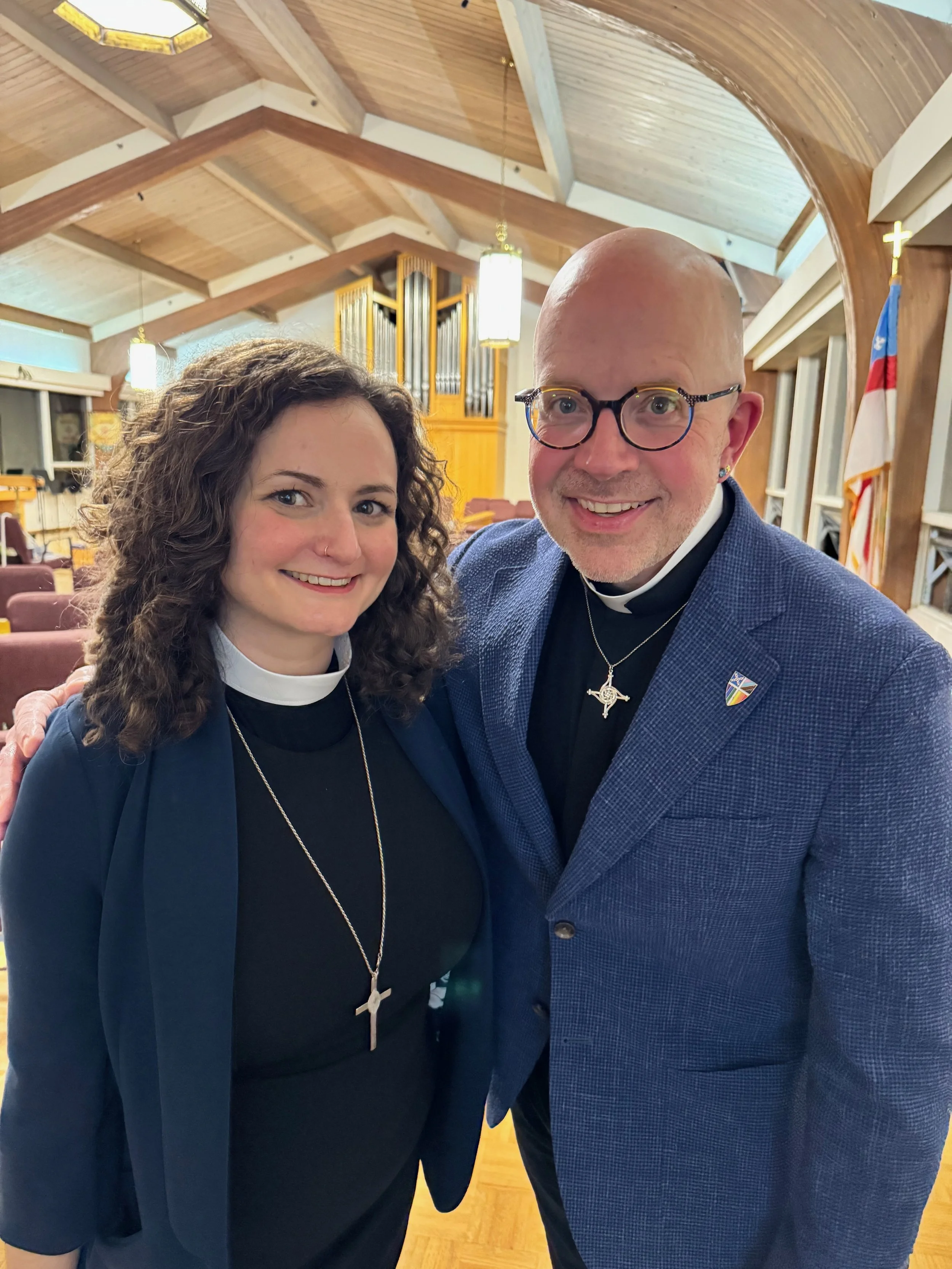
Left: The Rev. Elizabeth Riley, Rector of St. Dunstan’s Episcopal Church, Shoreline, Washington.
Click here to watch this sermon on video, at minute 24:50.
A rage prayer by the Reverend Elizabeth Riley.
Let us pray.
Despite the excess and abundance of the world,
So many go without, so many hunger and yearn
For the basic dignity of food.
For the disparities that sweep our world
Where children of God starve
While other children of God waste in excess,
We repent.
For greed, for our lack of humanity,
For every time we look away,
We repent.
For bellies that hunger,
We pray.
For caregivers desperate to provide,
We pray.
May we make no peace with a world that
hungers,
God forgive us.
Amen.
I became an Episcopalian in late 2005, and in all of the intervening twenty-one years I have been in discernment and ongoing formation for the holy orders of deacon and priest. In all of that time, at countless retreats and gatherings, I have heard one truly sublime statement of vocation. It was an “I” statement, a “This I believe” statement, a “This is the kind of deacon I am” statement; and it was made by the Reverend Sally Carlson. We deacons were gathered in a circle, reflecting on Christian vocation, and Deacon Sally said this: “My ministry is all about food.”
Sally opens the scriptures and reads what she finds there, and then she reaches for dishes and ingredients and prepares food for hungry people. She rallies others to her aid, and they lay out their pans of warm casseroles and baskets of fresh bread.
When we are all gathered on the mountaintop that the prophet Isaiah sings about, the mountaintop where God prepares “a feast of rich food, a feast of well-aged wines, of rich food filled with marrow, of well-aged wines strained clear,” the mountaintop where even alcoholics like me can drink that fabulous wine because on that great gettin’ up morning even we can have a glass or two and that will be enough, the mountaintop where God “swallows up death forever” — that is to say, on that mountaintop, while we are eating the abundant feast of rich food, God is snacking on death itself! — when we’re all up there and everyone has a full stomach, it will be Deacon Sally wearing the white apron and bossing the other cooks around (she’s a deacon, after all).
Sally, in her vocation, reminds me of my husband, a cook who owns every book written by Ina Garten and tons of French and Italian cookbooks too. One day about twenty-five years ago, I walked into the kitchen and started making dinner. “What are you doing?” Andrew said. “I thought I’d make dinner,” I replied, sensing that this was already not going well. He smiled, shook his head, and said, “I’ll do that.” He has been feeding me for a quarter century now. Andrew cooks dinner; I fold laundry. There are varieties of gifts.
But Andrew has something more to teach us about food and hunger, about Gospel and grace, something Deacon Sally can’t teach. Andrew is not a deacon; he is not bossy. Andrew is not a priest; he isn’t gathering folks for dinner. (“You’re front of the house,” he says to me.) But Andrew is a member of the vast, rainbow-diverse, mighty, and holy order of lay ministry. Jesus enjoys nineteen dinners in the Gospel of Luke (and those are just the ones we know about!), and there were plenty of laypeople at every one. So this is Andrew’s lesson: Feeding people isn’t for deacons only, priests only, bishops only. All the baptized are called into the kitchen, or to the front of the house, or out into the alleys and byways to find more hungry folk, or into the fields of grain and vine. Everyone has a role; everyone has a vocation; everyone joins the mission.
St. Dunstan’s knows this. You know it in your bones. And now you have called alongside you a faith leader and priest who has been feeding humans for some time now: after all, she is a parent. Elizabeth will stand here at this Table: this crossing of heaven and earth; this crisis-point of hunger and nourishment; this wondrous tiny location in the cosmos where the evening travelers watch the Risen One break the bread, and in that instant recognize him.
Elizabeth, as your priest, is called to represent Christ to you — no pressure, really, my friend — and also to represent you to Christ. Let’s focus on that second bit first. Elizabeth will represent you to Christ by praying for you, by holding you up to the Holy Three in prayer and supplication. Deacons are great prophets, but priests are blessed, and burdened, with the ministry of intercession on behalf of, and for, God’s people. Now, if Elizabeth prays for you — and be assured, she definitely will — you can expect that some of those prayers will be rage prayers.
I am a priest, if also a deacon, and I can tell you, there are days. “Help these stiff-necked people O God!” I occasionally breathe in my prayers to the Risen One. “Help them because honestly, I have just about had it with these holy fools!” Then I feel a flood of remorse and say, with honesty, “Help them be patient with me, for I am sometimes an old mule, sometimes a thoughtless fool, sometimes a disappointing failure.”
But then, maybe every prayer that Elizabeth prays to Christ in her vocation as your priest is a rage prayer. Even the mighty Eucharistic prayers you and she pray around this Table are rage prayers! Around this Table, we don’t begin with anger and lament. We recount all the wondrous acts of salvation, from creation down to the present day. We affirm that God fills our fields and vineyards with grain and fruit; God fills our hillsides with flocks; God fills our pantry shelves; God sets our Table of thanksgiving; and in Jesus God is our Table, our waiter, and our food, all three.
But then we get a little rage-y. We lament how we humans blew it. In one of our Eucharistic Rage Prayers we sing our sorrows this way: “We violated your creation, abused one another, and rejected your love.” We all confess these sins together, repent of them together, rage about them together. And then your priest leads you all back to God’s grace, God’s saving love, God’s compassion; and you affirm all of this by singing your Great Amen.
But that last bit — God’s compassion — let’s look closely at that.
Moments ago your deacon proclaimed this Good News to you: “When [Jesus] saw the crowds, he had compassion for them because they were harassed and helpless, like sheep without a shepherd.” In English, that sounds nice. Jesus is… nice. He has compassion for the roiling crowds. Aww! But in the Greek you hear a word for ‘compassion’ that reveals something about Jesus worthy of a book of rage prayers. ‘Compassion’ in the original Greek text of Matthew’s Good News is more like ‘gut-wrenching anguish.’
In the imagination of the ancient world Jesus knew, human compassion and mercy lived in our guts, in our bowels. We feel compassion for one another and for our neighbor in our bellies, in our intestines, in the place in our mortal vulnerable bodies where we digest that great mountaintop feast.
But again, all of you at St. Dunstan’s know this. You know the feeling of this gut punch, the feeling of nauseating compassion when you see great hunger in this wealthy country, great injustice and inequity, great and awful indifference to the plight of the hungry poor. You call yourselves “the church that feeds people,” and in this you are followers of the gut-wrenched, gutsy Jesus of Nazareth himself. He taught you that the mission is feeding people, full stop.
And now you have Elizabeth, who will work the front of the house while you deacons and lay missioners set God’s table in the wilderness. Let me plead with you: Elizabeth prays for you; please also pray for her, and her family. She holds you up; please also hold her up. She is well worth your prayers, your prayers that rise from your guts, through your heart, to the Compassionate One.
Ever the master of social media, your priest will evangelize: she will work the whole room, she will blow your trumpet, she will announce to a starving world that your dinner is ready. In all of this she represents Christ to you, for he is the One who noticed and then welcomed those crowds who were harassed and helpless.
As you labor together, I greet you from down the road, as the front-of-house host and priest at St. Paul’s in Uptown. I’m here to tell you that we love you, we’re with you, we cook soup every week for the crowds Jesus loves, and we can’t wait to lock arms with you and your new priest for many more years of mission in the name of the Compassionate One, the One who feeds the hungry world with himself.
***
Preached at the Celebration of Mutual Ministry, April 30, 2026, at St. Dunstan’s Episcopal Church, Shoreline, Washington.
1 Samuel 3:1-10
Psalm 63:1-8
Ephesians 4:11-16
Matthew 9:35-38