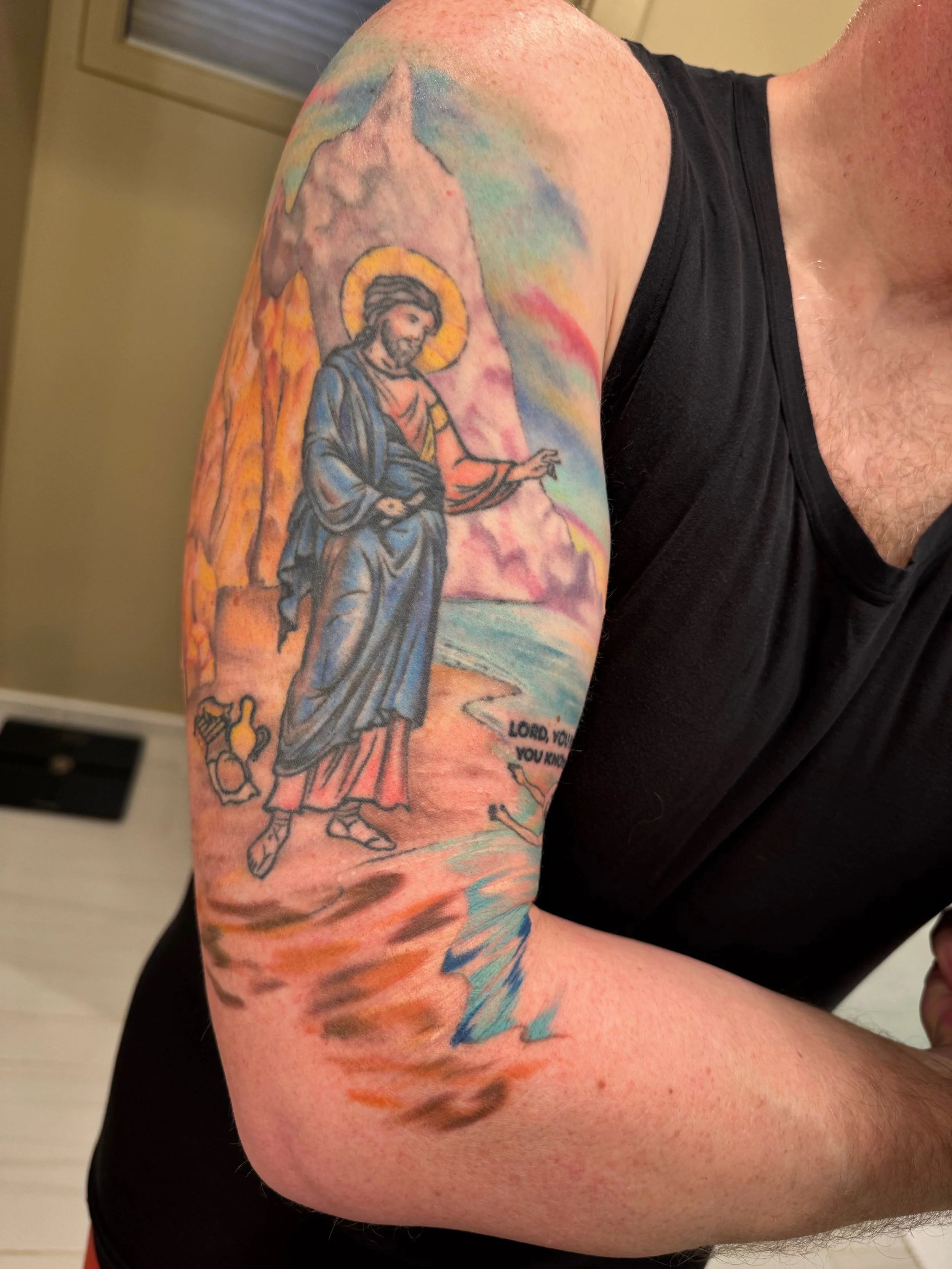
A tattoo of the breakfast scene in John 21, on my right arm.
Jesus said to them, “Come and have breakfast.”
Perhaps you are frightened right now. There is plenty to be frightened about. Climate change is causing heat waves in Europe, and hurricane season is coming: terrifying. But it isn’t just natural ecosystems that are changing or getting worse. Our political world roils in chaos, making Pride weekend all the more relevant and urgent, particularly for our trans companions. War ravages the land in West Asia, Africa, Europe, and along our borders. There was another mass shooting the other day, in Chico, California. A double earthquake has killed at least 1,400 people in Venezuela.
As we struggle through these crises, and (at our best) advocate for others in more extreme need, our chronic and intense anxiety could damage our health. Your fears about the world could finally generate a fear of their own: that your health and well-being will finally begin to break down under the relentless emotional strain.
Or perhaps your fear is closer to home. Maybe you are in a phase of life that daunts you: you are on the brink of adulthood, or you are a parent with a thousand fears about your child, or you are drawing close to the end of your life. Maybe you’re in one of the generations that can’t afford the basics, and you fear you’ll never pay your student loans; or you’re worried that your careful, reasonable plan for a comfortable and safe retirement is unraveling. Or you’re in midlife, and you’re wondering with nagging worry about the meaning of your life, worry about the health of your relationships, worry about the purpose of your career. Maybe you’re coping with addiction: no matter whether you or someone you love is the actual substance user, addiction is a social disease that damages the health of everyone involved, and locks whole families in excruciating fear.
Are you frightened right now? Jesus said to them — Jesus says to you — “Come and have breakfast.”
Perhaps you are angry right now. There is plenty to be angry about. Perhaps you are gripped by remorse or regret. Or maybe it is loneliness that strikes the most unnerving bell in the depths of your spirit. Jesus says to you, “Come and have breakfast.”
But it is quite a breakfast. You might want to pause before you sit down and tuck in. First, Jesus invites you, and me, and all of us, to bring forward some of our catch of fish. We may have fished in vain all night long, but suddenly, thanks to the risen Stranger by the sea, we have such a great catch, full to bursting, such a full load, that our boat nearly capsizes under its weight. And there’s such a variety of fish! One hundred fifty-three different kinds.
Why one hundred fifty-three? Honestly, we Christians have lost a clear memory of the reason. Maybe St. Jerome had it right, that in the Greek world at the time of Jesus, folks thought there were one hundred fifty-three species of fish, and it symbolized the Gospel being brought to every culture and language and people and nation. But we can’t be sure that that’s what John the Evangelist meant.
I would like to offer an interpretation, which rests only on my own tiny, historically insignificant authority. (You are free to reject this interpretation, and I offer it with as much humility as I can muster.) I say the one hundred fifty-three different kinds of fish means that Jesus brings forth from our labor every kind of gift, every challenge, every grief, every joy, every regret, every triumph, every insight, every quandary, every hope, every disappointment, every possible blessing, and even a curse or two. Throwing our briny net over the other side of the boat — for that is what the risen Stranger suggested we do — the net fills with the fruits of our labor, with all of these valuable but also difficult and even upsetting things.
And then Jesus chooses from our catch a few particular fish to grill for our breakfast. Another biblical scholar suggested that this breakfast of grilled fish in John is an allusion to the great sea beast that swims through the Hebrew bible, the same awesome creature who obeyed when God told it to swallow up Jonah. The great sea beast becomes for Jonah a tomb, but also a womb, and then, when Jonah, still trapped in the wet and pitch-dark guts of the beast, finally faces his fears and acknowledges his errors, the great fish obeys God again and vomits Jonah out onto dry land.
As much as I admire that fish for doing as it was told (something that Jonah mightily struggled against), I know that the sea beast is most often a symbol of chaos and destruction, in both testaments of our bible. The sea beast can represent all that is rebelling against God, or all the forces that rage against the Holy Spirit. So Jonah went into chaos, realized his grave errors, repented, and was spit back out. And now, that beast of chaos is sizzling on the grill, devoured by the anxious, angry, remorseful, lamenting disciples of the risen Stranger.
Maybe the fish Jesus grills is the sea beast. Or maybe the sea beast is just one of the fishes to which he has access, and he’ll need more if he’s going to feed all of us.
So Jesus then asks us for our fish, the ones we caught as we labored in the pre-dawn twilight. Some of the fish we caught are as dreadful as the sea beast. Here are some of the fish we give to Jesus, to be grilled for our breakfast:
We give Jesus our fears, for him to gut, clean, and lay flat on the gridiron. “Do not be afraid,” we are told, again and again, by Jesus and also by God’s messengers, the Angels.
We give Jesus our angers and hatreds, our resentments and mulish resistance, our reluctance to commend the faith that is in us, the fish of contempt that we clutch in our sweaty hands. Jesus takes it and slices it open, readies it to feed and nourish us as fuel for the mission.
We give Jesus the fish of remorse, of gut-wrenching regret, our sorrow about how we’ve fallen short, our shame for how we chose the low road, our anguish that we failed to stand bravely next to the oppressed, or work confidently alongside those who are lonely, hungry, sick, and afraid. Jesus cooks that fish into tender fillets that fill and warm us with forgiveness and reconciliation — with reconciliation not only with our neighbor and one another, but with ourselves.
And of course we readily — eagerly — hand Jesus the fish of grief. Heartsick and homesick, worn out by our weeping at the graves of our friends, Jesus is (impossibly, incredibly) wiping his wounded hands on a chef’s apron, asking us if we’d like a second helping.
There is joyous and splendid mercy at this seaside breakfast, words of comfort, healing food, the warmth of the fire when the morning is still clinging to the chill of a long night. Hear this Good News; hear these glad tidings. Hear them and rejoice. For this — this Eucharistic Table — this is the location of our seaside breakfast with Jesus, who finally offers himself in place of the dreaded sea beast as the fish we frantically consume with our ravenous bodies and our broken hearts. “Come and have breakfast,” he says, and we find in the end that Jesus himself is our nourishment, Jesus himself is our food.
But, this being Jesus, there is a calling, a correction, a command: nourished by (and on) the Risen One, the Good Shepherd, we are sent to feed his lambs, to tend his sheep, to feed his sheep. His breakfast will hardly nourish us if we don’t share it with everyone else we meet, everyone else we serve, even those we dislike, those we fear, those we find abhorrent.
And there will be enough fish for them all. One hundred fifty-three: a strangely specific number and an unsolvable biblical riddle, but it’s easy enough to see it as a sign of both abundance and diversity, a throng of companions, some of them marching downtown today in defiant advocacy for queer human beings who bear God’s image just like every other human person in this existential age. But there’s no litmus test for who deserves the grilled fish, the grilled Body of Christ, the toasted Bread of Heaven. That wretched enemy of yours: Jesus calls out “Come and have breakfast” to them, as surely as he calls it out to someone you may have harmed, and to you.
For everyone to get close enough to the bright and warming campfire, we will have to make room in our company for all of them. And we will have to accept some awkward discomfort as we get awfully snug on this beach.
After all, remember the words of the prophet Ezekiel, through whom God says, “I will seek the lost, and I will bring back the strayed, and I will bind up the injured, and I will strengthen the weak.” It’s going to be a big and crowded breakfast around this Table.
Will you join us?
***
Preached on the (transferred) Feast of Saints Peter and Paul, June 28, 2026, at St. Paul’s Episcopal Church, Seattle, Washington.
Ezekiel 34:11-16
Psalm 87
2 Timothy 4:1-8
John 21:15-19